
The Landlord’s Monthly Close: Tracking Rent and Expenses So Schedule E Takes an Afternoon
If you own a handful of rental units, tax season probably looks like this: a shoebox of receipts, a year of bank statements, and a weekend of trying to remember what that $212 charge in June was for. There is a simpler way. A short monthly close — logging rent and expenses the day they happen, assigning every expense a Schedule E category as you go, and reconciling once a month — turns Schedule E into an afternoon of exporting totals instead of a weekend of archaeology. This article walks through the routine. It is an organizational aid, not tax advice; the goal is a clean set of records you or your tax preparer can trust.
What should you log the day it happens?
Two things, and only two: money in and money out.
Money in is rent received — the amount, the date it actually landed, the unit it belongs to, and how it was paid. Log it the day it arrives, not the day it was due. If a tenant pays half now and half on the 15th, that is two entries. Partial payments, late fees you actually collected, and security deposits handled according to your state’s rules all get their own lines, because “roughly $2,400 a month” is exactly the kind of guess that falls apart in April.
Money out is every expense, logged with four fields: date, amount, property, and category. The category is the Schedule E category you expect the expense to land in — the IRS form’s standard categories include lines for items such as advertising, cleaning and maintenance, insurance, mortgage interest paid to banks, repairs, supplies, taxes, and utilities, among others. You are not making a legal determination when you pick a category in March; you are making a note to your future self while you still remember what the charge was. Your preparer can move anything that needs moving, and a note that says “repairs — replaced the kitchen faucet, Unit B” is infinitely easier to move than a bare bank line that says “HARDWARE STORE $84.12.”
The habit that makes this work is capturing the receipt the same day. Photograph it, forward the email invoice to yourself, drop it in one folder per property. Ten seconds in March saves ten minutes next April.
What does the monthly close checklist actually look like?
Set one fixed day — the 1st, the 5th, whenever rent is fully in — and run the same five steps every month. The whole close should take about half an hour for a few doors.
First, reconcile against your bank statements. Match every rent deposit and every expense in your log to a line on the statement. Anything on the statement that is not in your log gets added; anything in your log with no matching statement line gets a note. This is the step that catches the forgotten insurance autopay and the repair you logged twice.
Second, chase late rent while it is still this month’s problem. Your log shows who is short, by how much, and since when. A polite nudge on day 35 is a conversation; discovering a shortfall in March is a loss you cannot fix.
Third, file the month’s receipts. Move the month’s photos and invoices into that property’s folder, named by month. If you reconcile with a receipt missing, this is the moment to find it — not during tax week.
Fourth, glance at the totals by category. You are not doing tax work; you are sanity-checking. If repairs are triple last month’s, you already know why. If a category looks empty that should not be, something is being logged wrong.
Fifth, write one line about anything odd. “Unit A tenant paid January rent on Dec 30.” “Insurance premium is annual, paid in full this month.” These one-liners are what turn questions from your preparer into answers you can give in seconds.
Why does the category you pick in March matter next April?
Because Schedule E is organized by category, and by property. When April comes, the form does not ask “what did you spend?” — it asks, for each property separately, how much went to each category. If your records are a single undifferentiated stream of transactions, someone has to re-sort a year of them by hand, making judgment calls about purchases they did not make, months after the fact. That someone is either you, on a weekend, or your preparer, at their hourly rate.
Category discipline during the year removes the sorting step entirely. You are not deciding the final tax treatment of anything — repairs versus capital improvements, for instance, is a distinction with real rules behind it, and it is exactly the kind of call to confirm with a tax professional. What you are doing is recording, at the moment of maximum information, what you bought and what it was for. The decision can be reviewed later; the memory cannot be recovered later.
Why keep every property separate from day one?
Schedule E reports each rental property in its own column, so records that blend two buildings together have to be un-blended before anything can be filed. The fix costs nothing during the year: a property field on every entry, and one folder per property for receipts. Shared expenses — a truck, a software subscription, one insurance policy covering two buildings — will happen. Log them against the property they primarily serve and add a note, or split them at entry time; either is fine as long as the method is written down and consistent. What you want to avoid is a single annual “landlord expenses” bucket that someone must dissect later.
What does a worked month look like?
Here is one month for one small duplex — every figure in this example is illustrative.
Rent received (illustrative): Unit A paid $1,250 and Unit B paid $1,150, for total rent of $2,400 for the month.
Expenses logged during the month (illustrative): mortgage interest $612, insurance $148, a plumbing repair $95, supplies $37, and property taxes $290.
Total expenses for the month (illustrative): $612 + $148 + $95 + $37 + $290 = $1,182.
Net for the month before other considerations (illustrative): $2,400 in rent minus $1,182 in expenses = $1,218.
Notice what the close produced: not just a net number, but $2,400 of rent split by unit and $1,182 of expenses already sorted into the categories a preparer will ask about. Repeat that twelve times and the year-end question “what were your totals?” is answered by adding twelve monthly totals you already trust.
What goes in the year-end pack you hand a tax preparer?
Because the monthly closes are done, the year-end pack is mostly assembly:
- A summary per property: total rent received, and total expenses by category, for the year.
- The monthly logs behind the summary, so any figure can be traced to a dated entry.
- The receipt folders per property, organized by month.
- Notes on the odd items you flagged during the year — partial payments, the annual insurance premium, deposits — written while you remembered them.
Hand a preparer that pack and their job becomes reviewing and filing rather than reconstructing. The questions they do ask will be real tax questions, which are the ones worth paying them for.
A tool that keeps the routine in one place
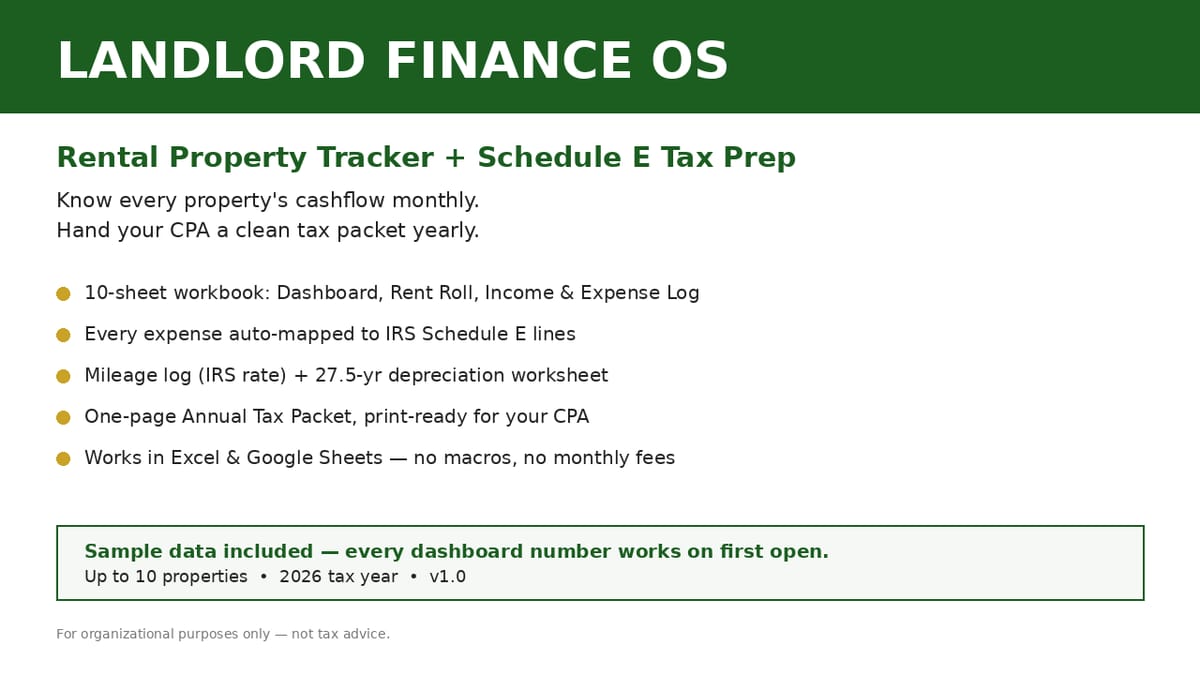
The routine above needs nothing more than a spreadsheet and the discipline to open it; if you want the structure pre-built, Landlord Finance OS is a spreadsheet tracker for landlords covering rent and expense logging organized around Schedule E categories, for $24: https://dastideals.gumroad.com/l/landlord-finance-os Full disclosure: I run Dasti Deals, the store that sells it.
Frequently asked questions
Is this tax advice? No. This is a record-keeping routine. It helps you arrive at tax time with organized numbers; how those numbers are treated is a question for a tax professional who knows your situation.
Do I really need to log things the day they happen? The day is ideal, the month is the deadline. Logging at the monthly close, while statements and receipts are in front of you, captures almost all of the benefit. Logging once a year captures almost none of it.
What if I own just one single-family rental? The routine scales down fine — one property, one folder, a close that takes ten minutes. The per-property and per-category habits matter most once you add a second door, and they are free to build now.
Can I just hand my preparer my bank statements instead? You can, but statements do not say which property a charge belongs to or what it was for, and they include personal spending if the account is shared. Sorting that out is slower and usually billed by the hour.
What about depreciation and major improvements? Track the purchase and keep the paperwork with the property’s records, and flag it in your notes. How a major improvement is treated is a rules-based decision — confirm it with your tax professional rather than guessing from a category label.
Closing
None of this makes taxes fun. It makes them boring, which is the achievable goal: rent logged when it lands, expenses carrying their property and category from the day they occur, one short reconciliation a month, and a year-end pack that assembles itself. Keep the records organized all year and Schedule E becomes an afternoon of exporting, not a weekend of guessing. One more time, plainly: this article is an organizational aid, not tax advice — confirm the tax treatment of your situation with a qualified professional. If you want the rest of the Dasti Deals library of small-business and landlord tools, the hub is here: https://beacons.ai/dastideals

Landlord Finance OS
Stop drowning in one-spreadsheet-per-property chaos. Track rent, expenses, and cashflow for up to 10 properties — and turn your year into a CPA-ready tax packet mapped to IRS Schedule E lines. Works in Excel & Google Sheets.