A Wedding Budget That Survives Contact With Real Quotes
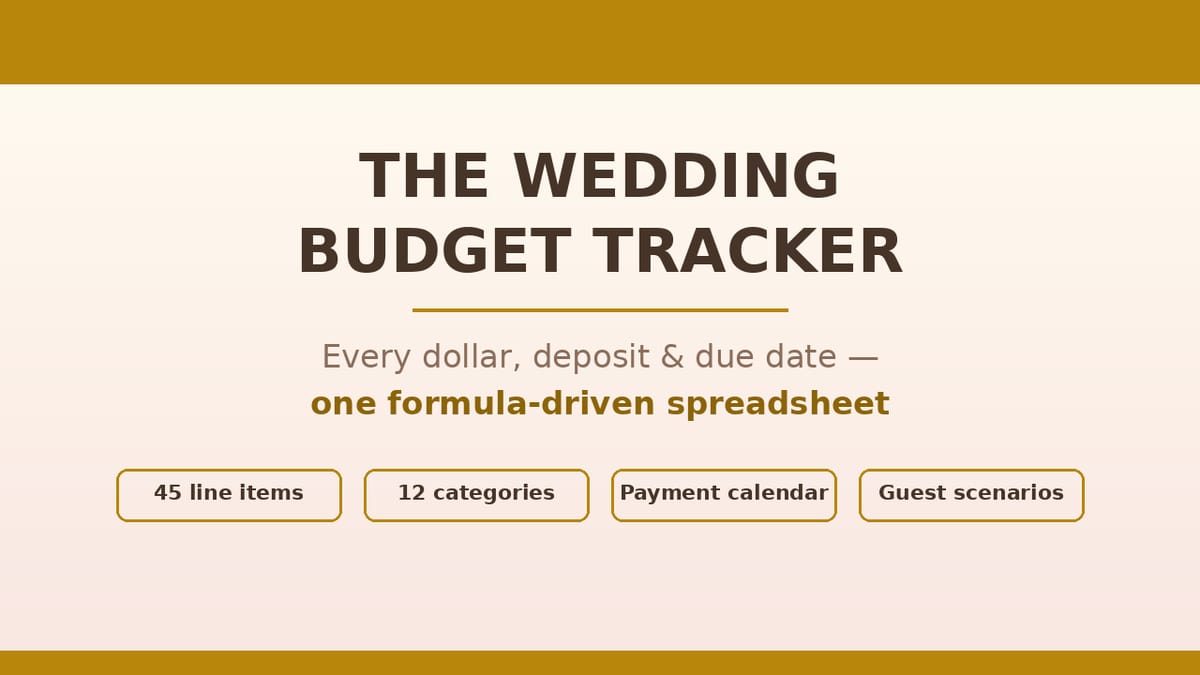
A lump-sum wedding budget fails because money never leaves in a lump — it leaves category by category, quote by quote, and the first three vendors you book can quietly eat the money the last three needed. The system that survives real quotes has four parts: a budget set by category from actual prices, a payment schedule that maps every deposit and balance to a month, the per-guest cost worked out before the guest list is final, and a ledger for family contributions and gifts — with a buffer line living inside the budget the whole time.
How do you set a wedding budget by category instead of one lump sum?
Start with your total, then split it before you book anything. A category budget is simply your total divided into named pots — venue, catering, attire, photography, music, flowers, cake, stationery, rentals, rings — each with its own ceiling. The ceiling is what protects you: when the florist quotes more than the flowers pot holds, you see the problem the day the quote arrives, not three months later when the money is already spent elsewhere.
Set each pot from evidence, not from a percentage you found online. Get one or two real quotes for the big three first — venue, catering, and photography usually take the largest share — then size the remaining categories around what is left. If the first quotes come in higher than expected, adjust the pots on paper while adjusting is still free. A category you have not priced yet gets a placeholder pot and a note to quote it early; an unpriced category with no pot at all is where budgets go to die.
Then treat the pots as semi-flexible, not sacred. Money can move between categories, but only as a deliberate transfer you write down: “moved $200 from stationery to flowers.” The moment transfers happen silently in your head, you are back to a lump sum with extra steps.
Revisit the split once, after the big three are booked. Early pots are educated guesses; signed contracts are facts. If the venue came in under its pot and photography came in over, rebalance the two lines to match reality and note the date you did it. After that one reset, stop re-planning and start tracking — a budget you redraw every week is just a lump sum wearing a costume. The categories earn their keep in the months when nothing changes: every new quote gets tested against the pot it belongs to, and either it fits, or you consciously take the difference from somewhere named.
Why does the buffer belong inside the budget, not outside it?
Most couples keep a buffer as a vague idea — “we’ll find a little extra if we need it” — which means the buffer is the first thing spent and the last thing tracked. Put the buffer in as its own category line, inside the total, from day one. If your total is fixed, the buffer is funded by trimming the other pots slightly, which is honest: you are admitting up front that something will cost more than quoted.
A buffer inside the budget does two jobs. First, it absorbs the small certainties of wedding planning: delivery fees, a second hair trial, postage, an extra hour of photography. Second, it makes overruns visible. When a category goes over, you transfer from the buffer line on paper, and you can watch the buffer shrink across the months. A shrinking buffer is an early-warning system; a surprise bill is not.
How do you build a payment schedule so deposits don’t ambush you?
A wedding budget can be perfectly “on budget” and still break you in a single month, because what matters is not only how much you owe but when you owe it. For every vendor, record three things beside the category: the deposit amount and its due date, any mid-payment, and the final balance and its deadline. Then lay those dates over a calendar and total what leaves your account each month.
Do this before you sign, not after. Two vendors whose balances both land in the wedding month may be fine; two large deposits landing in the same month as your rent increase may not be. When you can see the schedule, you can negotiate timing calmly — many vendors will shift a mid-payment by a few weeks if you ask before signing rather than after.
Keep one more view beside the schedule: everything due in the next sixty days, totalled. Final balances love to cluster in the last fortnight, and deposits cluster at booking time, so the sixty-day view is where cash-flow surprises show up while they are still small. If the next sixty days total more than you can comfortably pay, that is a conversation to have with a vendor now — about moving one date — not in the week the money is due.
The schedule also tells you how much to set aside monthly. Add up everything due before the wedding, subtract what you have already saved, and divide by the months remaining. That is your real monthly savings target — a much more useful number than the total budget, because it is the one your bank account actually has to meet.
What does one more guest actually cost?
This is the silent budget killer, because guests are not free once the venue is booked. Every guest carries a per-head cost: catering, the rentals that scale with place settings, a slice of the cake, and a favor if you are doing them. Work that number out once, honestly, and every guest-list argument becomes arithmetic instead of emotion.
Here is the calculation with illustrative figures. Say the total budget is $24,000 (illustrative), split into category pots like this: venue $4,600, catering $6,000, attire and beauty $2,200, photo and video $2,600, music $1,100, flowers and decor $1,300, cake $550, stationery $450, rentals, favors and extras $1,260, rings and license $800, and a buffer line of $3,140 — all illustrative, and they add up to the stated $24,000 total. (Illustrative: 4,600 + 6,000 + 2,200 + 2,600 + 1,100 + 1,300 + 550 + 450 + 1,260 + 800 + 3,140 = 24,000.)
Now the per-guest math for 120 guests, all illustrative: catering at $46 per head comes to $5,520, which fits inside the $6,000 catering pot. Rentals at $7.50 per head and favors at $3 per head come to $10.50 per guest, or $1,260 in total — exactly the rentals, favors and extras pot. Cake at $4.50 per head comes to $540, inside the $550 cake pot. Add the per-head pieces together — $46 + $10.50 + $4.50 — and one guest costs $61 (illustrative). All 120 guests together account for $7,320 of the budget (illustrative).
So what does adding 20 guests really cost? Twenty times $61 is $1,220 (illustrative) — not “nothing, the venue is already paid for.” In this example the buffer absorbs it on paper: $3,140 minus $1,220 leaves $1,920 of buffer (illustrative), and you can see exactly what the bigger guest list traded away. That is the conversation to have with the numbers open, whichever way you decide.
How do you track family contributions and gifts without double-counting?
Family money causes a quiet accounting error: a contribution gets counted once as “help with the wedding” and again as room in the budget, and suddenly the same money is spent twice. Keep a simple contributions ledger next to the budget: who gave what, when it arrived (not when it was promised), and which category it is assigned to.
Assign each contribution to one category and mark that category as part-funded. If parents contribute $3,000 (illustrative) toward catering, the catering pot stays at its planned size, but $3,000 of it is now covered — so the amount you personally still need to fund across the whole budget drops from $24,000 to $21,000 (illustrative). The pot does not grow to $9,000 unless everyone explicitly agrees the gift is extra rather than help. That one distinction — covering a cost versus enlarging the budget — prevents most double-counting.
Cash gifts from guests are simpler: they arrive after most bills are due, so never build them into the plan. If they come, they are a pleasant recovery of money already spent, not funding for money you are about to spend. Log them in the same ledger for thank-you notes, and keep them out of the budget maths entirely.
What does a monthly budget check-in look like?
Once a month, sit down with the budget for twenty minutes — the same ritual, the same four questions. What did we actually pay this month, and does it match the payment schedule? Which categories are over or under their pots, and do we need a written transfer from the buffer? What deposits or balances land in the next sixty days? And has the guest count changed, and if so, what does the per-guest number say that costs?
Update actual spending beside every category pot, so each line always shows three numbers: budgeted, spent, remaining. That single view is the whole system working — categories holding their shape, the buffer visibly doing its job, the schedule telling you what next month demands. Couples who do this rarely get ambushed, because the ambushes show up as small line items weeks early, while they are still cheap to fix.
The tool matters less than the structure, but the structure has to live somewhere you will actually open it. The Wedding Budget Tracker is a formula-driven wedding budget spreadsheet with category budgets, a payment schedule, and a per-guest cost calculator (Excel & Google Sheets), priced at $19: https://dastideals.gumroad.com/l/wedding-budget-tracker Full disclosure: I run Dasti Deals, the store that sells it.
Frequently asked questions
We already set one lump-sum budget. Is it too late to split it? No. Splitting takes an hour: list what you have already booked at its real price, assign each booking to a category, then divide what is left among the unbooked categories and a buffer line.
How big should the buffer be? Big enough that it has its own line and you can watch it move. In the illustrative example above it is $3,140 of a $24,000 budget, but the right size is whatever remains after your real quotes set the other pots — the principle matters more than the percentage.
Both families keep adding guests. What do we do? Run the per-guest calculation with your real quotes and show everyone the figure for the full list they are proposing. Arithmetic ends most of these arguments kindly, because nobody is saying no — the budget is.
A relative offered to pay a vendor directly. How do we record it? In the contributions ledger: the amount, the vendor, and the category it covers. The category pot stays the same size; the funded-by-family portion is simply marked as covered.
Do we need special software for this? No. Categories, a payment schedule, a per-guest figure, and a contributions ledger work on paper or in any spreadsheet. What matters is that budgeted, spent, and remaining sit side by side and get checked monthly.
A closing note: a budget is a planning tool, not a guarantee. Prices vary widely by region, season, and vendor, and the only figures that mean anything for your wedding are your own real quotes — so collect them early, put them in categories, and let the system do the worrying. You can find more Dasti Deals planning tools at https://beacons.ai/dastideals
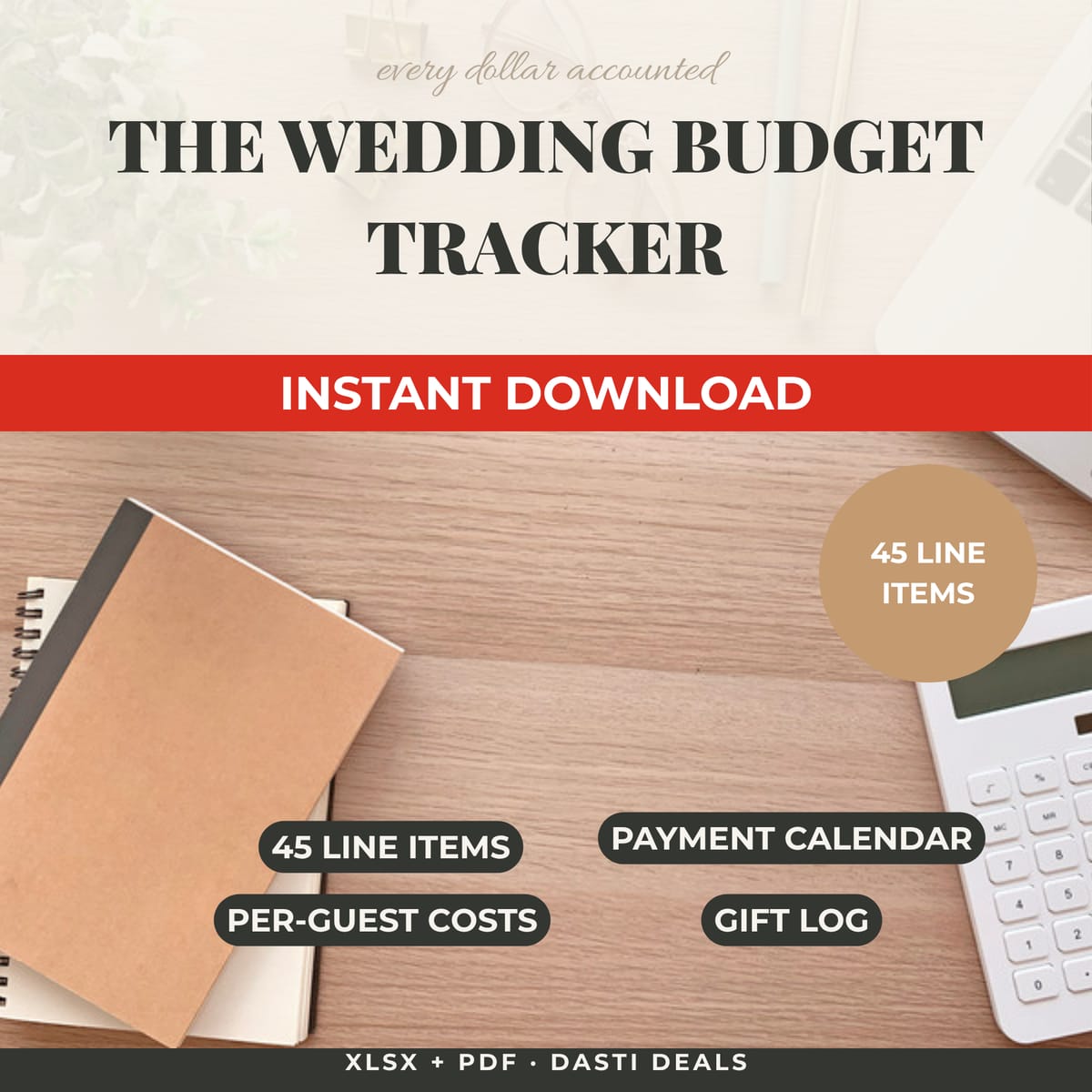
The Wedding Budget Tracker
A live financial model of your wedding in one spreadsheet: 45 line items across 12 categories, a payment calendar, per-guest cost scenarios, and a dashboard that flags over-budget categories. Every total is a real formula.