She is not the disruptive kid. She is the one staring out the window, losing the thread mid-sentence, forgetting the assignment she wrote down somewhere. The quiet kind of ADHD gets missed — by teachers, by parents, sometimes by the girl herself. This book is written TO her.
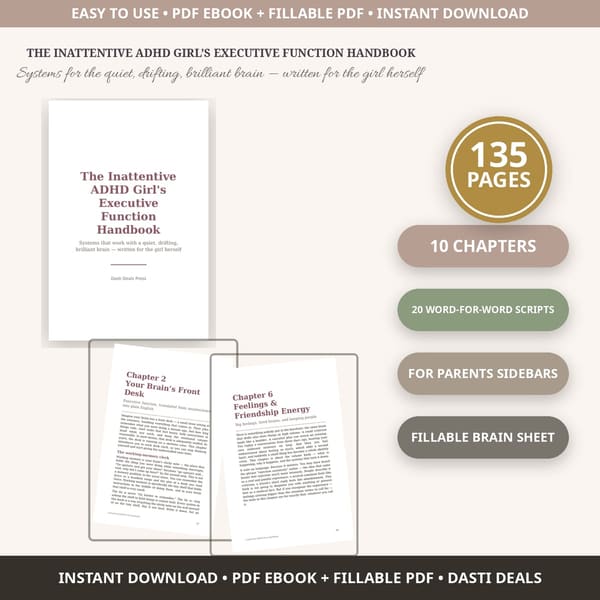
This 135-page handbook (36,954 words) translates executive function into plain language — your brain's "front desk" team — and then gives her systems that work WITH a drifting brain instead of against it:
SCHOOL SURVIVAL — a planner that survives the school day, the homework launch ritual, studying in sprints, word-for-word scripts for asking teachers for help.
TIME BLINDNESS FIXES — visible clocks, named alarms, morning countdown chains, the estimating game that teaches her brain what time feels like.
STUFF & SPACE — one home for every important thing, the launch pad by the door, the backpack reset, room zones that forgive mess.
FEELINGS & FRIENDSHIP — the after-school collapse, reply systems, social battery management, scripts for asking for space kindly.
THE MASKING TRAP — performing "fine" all day and crashing at home; unmasking safely, room by room.
DIGITAL LIFE — phone parking spots, homework-vs-scroll brakes, a sleep- protecting charging system she designs herself.
TALKING TO ADULTS — self-advocacy scripts for parents, teachers, and coaches; how to prepare for a clinician appointment (questions to ask, what to track — educational only, never diagnostic).
DESIGNING HER OWN SYSTEMS — the personal systems audit and the semester upgrade ritual, so the book keeps working after the last page.
10 CHAPTERS, each ending with a "One Small System" box — the single takeaway to install that week. Plus a FOR PARENTS sidebar in every chapter (visually distinct), a printable weekly planner and morning/ evening chain cards, a 20-script library collected in Appendix B, and a fillable "How My Brain Works" sheet she can fill in and hand to any adult.
DIFFERENT FROM OUR OTHER ADHD BOOKS: Product 81 ("The Zero-Nagging Executive Function Playbook") is written mostly for families of teens generally, with a parent co-pilot. THIS book centers the inattentive presentation specifically — quiet daydreaming, internal restlessness, masking, losing things, time blindness — and speaks directly to the girl herself (ages ~11-17). Product 88 is for college freshmen living alone. This one is for the school-age girl, with parent sidebars but HER voice leading.
WHAT THIS BOOK IS NOT: Educational information only — not medical, psychological, or therapy advice. It does not diagnose or treat ADHD or any condition; a diagnosis belongs to qualified clinicians. Rejection sensitivity is described as a commonly-reported experience, not a diagnosis. No crisis content — where emotions get heavy, the book points to trusted adults and school counselors. Body/puberty topics stay at the level of practical routines, never medical guidance.
School Survival — a planner that survives the school day, the homework launch ritual, studying in sprints, word-for-word scripts for asking teachers for help
Time Blindness Fixes — visible clocks, named alarms, morning countdown chains, the estimating game that teaches her brain what time feels like
Stuff & Space — one home for every important thing, the launch pad by the door, the backpack reset, room zones that forgive mess
Feelings & Friendship — the after-school collapse, reply systems, social battery management, scripts for asking for space kindly
The Masking Trap — performing "fine" all day and crashing at home; unmasking safely, room by room
Digital Life — phone parking spots, homework-vs-scroll brakes, a sleep-protecting charging system she designs herself
Talking to Adults — self-advocacy scripts for parents, teachers, and coaches; how to prepare for a clinician appointment (questions to ask, what to track — educational only, never diagnostic)
Designing Her Own Systems — the personal systems audit and the semester upgrade ritual, so the book keeps working after the last page
Every chapter ends with a "One Small System" box — the single takeaway to install that week
A FOR PARENTS sidebar in every chapter (visually distinct)
A printable weekly planner and morning/evening chain cards
A 20-script library collected in Appendix B
How-My-Brain-Works-Fillable.pdf — the fillable "How My Brain Works" sheet (8 fillable fields) she can fill in and hand to any adult
README-license.txt — license + disclosures
Key features
Written TO the girl herself → her voice leading, ages ~11–17, with parent sidebars in every chapter
Executive function in plain language → the brain's "front desk" team, explained without jargon
School survival system → a planner that survives the school day, the homework launch ritual, studying in sprints
Time blindness fixes → visible clocks, named alarms, morning countdown chains, the estimating game
The masking trap → performing "fine" all day and crashing at home; unmasking safely, room by room
Self-advocacy scripts → word-for-word scripts for teachers, parents, and coaches, in a 20-script library (Appendix B)
"One Small System" box ends every chapter → the single takeaway to install that week
Fillable "How My Brain Works" sheet → she fills it in and hands it to any adult
Designing her own systems → the personal systems audit and semester upgrade ritual keep it working after the last page
Frequently asked questions
Is this medical, psychological, or therapy advice?
No — educational information only: not medical, psychological, or therapy advice. It does not diagnose or treat ADHD or any condition; a diagnosis belongs to qualified clinicians.
Who is it written to — the girl or her parents?
To the girl herself (ages ~11–17), with her voice leading. Parents get a visually distinct FOR PARENTS sidebar in every chapter.
How is it different from Product 81?
Product 81 (The Zero-Nagging Executive Function Playbook) is written mostly for families of teens generally, with a parent co-pilot. This book centers the inattentive presentation specifically. Product 88 is for college freshmen living alone; this one is for the school-age girl.
Does it cover rejection sensitivity?
It is described as a commonly-reported experience, not a diagnosis.
What about heavy emotions or crisis topics?
There is no crisis content — where emotions get heavy, the book points to trusted adults and school counselors. Body/puberty topics stay at the level of practical routines, never medical guidance.
What's fillable?
The "How My Brain Works" sheet (8 fields) — she can fill it in and hand it to any adult. The weekly planner and morning/evening chain cards are printable, as often as you like.
The Inattentive ADHD Girl's Executive Function Handbook
She is not the disruptive kid — she is the one staring out the window, losing the thread mid-sentence. This 135-page handbook is written TO her: executive function in plain language, and systems that work WITH a drifting brain instead of against it — school survival, time blindness fixes, the masking trap, self-advocacy scripts, and a fillable "How My Brain Works" sheet.
The reminding isn't a discipline problem — it's a system problem. This 173-page playbook replaces nagging with thirty tiny, permanent systems teens build themselves — each one doing a job the brain shouldn't have to do alone.
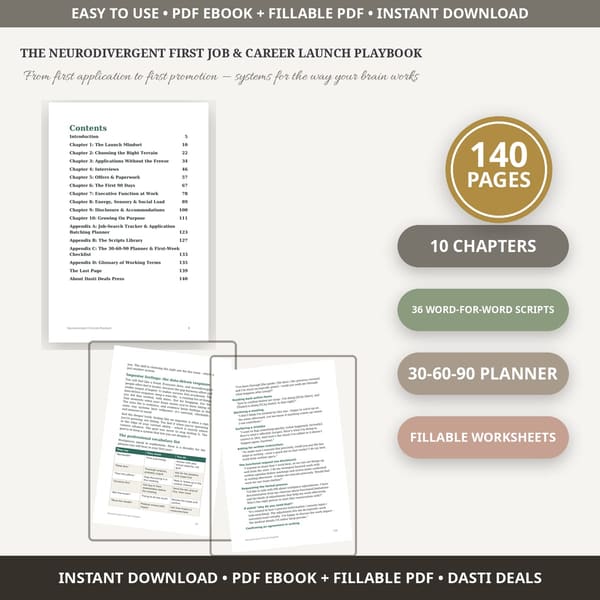
School had clear rules; work has unwritten rules nobody teaches. This 140-page playbook closes the gap for a neurodivergent brain — with systems, not willpower: job search, interviews, offers, the first 90 days, disclosure decisions, manager communication, and deliberate growth — plus 36 word-for-word scripts and a fillable worksheets pack.
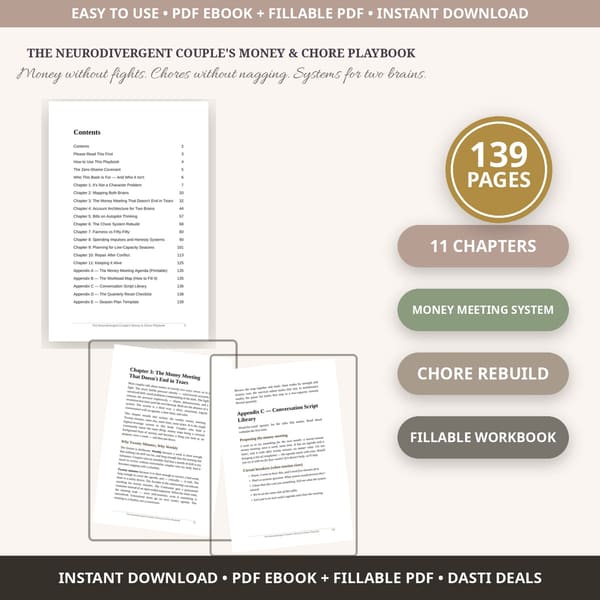
A practical household-systems playbook for couples where one or both partners are neurodivergent — and where money and chores generate more conflict than they should. Eleven chapters build a complete two-brain household operating system, plus a 14-page fillable workbook with 98 fields.
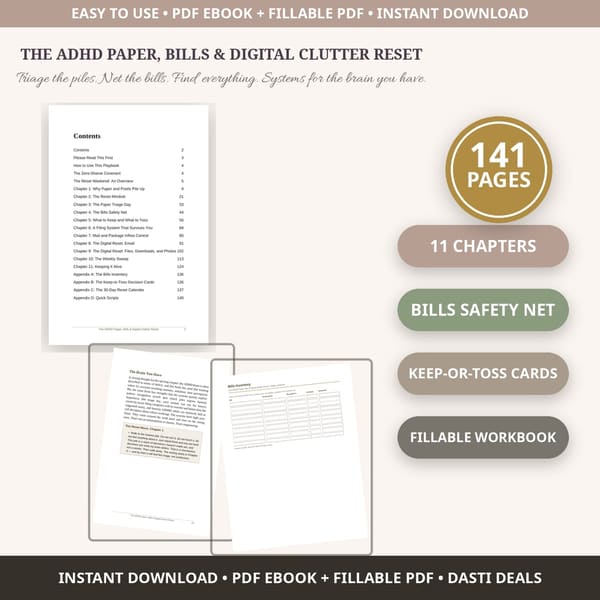
The final book in the Dasti Deals ADHD series: a 141-page reset system for paper piles, unpaid/lost bills, overflowing inboxes, chaotic downloads, and photo libraries — built for the brain you have. With a fillable 9-page workbook (141 fields) and a "Reset Move" at the end of every chapter.