School had clear rules: syllabi, deadlines, grades. Work has unwritten rules, invisible expectations, and a social layer nobody teaches. For a neurodivergent brain, the gap between "qualified for the job" and "surviving the job" can feel enormous. This playbook closes it — with systems, not willpower.
This 140-page playbook (36,739 words) is written for the young professional (roughly 18-30) launching a career: job search, interviews, offers, the first 90 days on the job, disclosure decisions, manager communication, and deliberate growth. Every chapter ends with a "Launch Move" — one concrete action you can take this week.
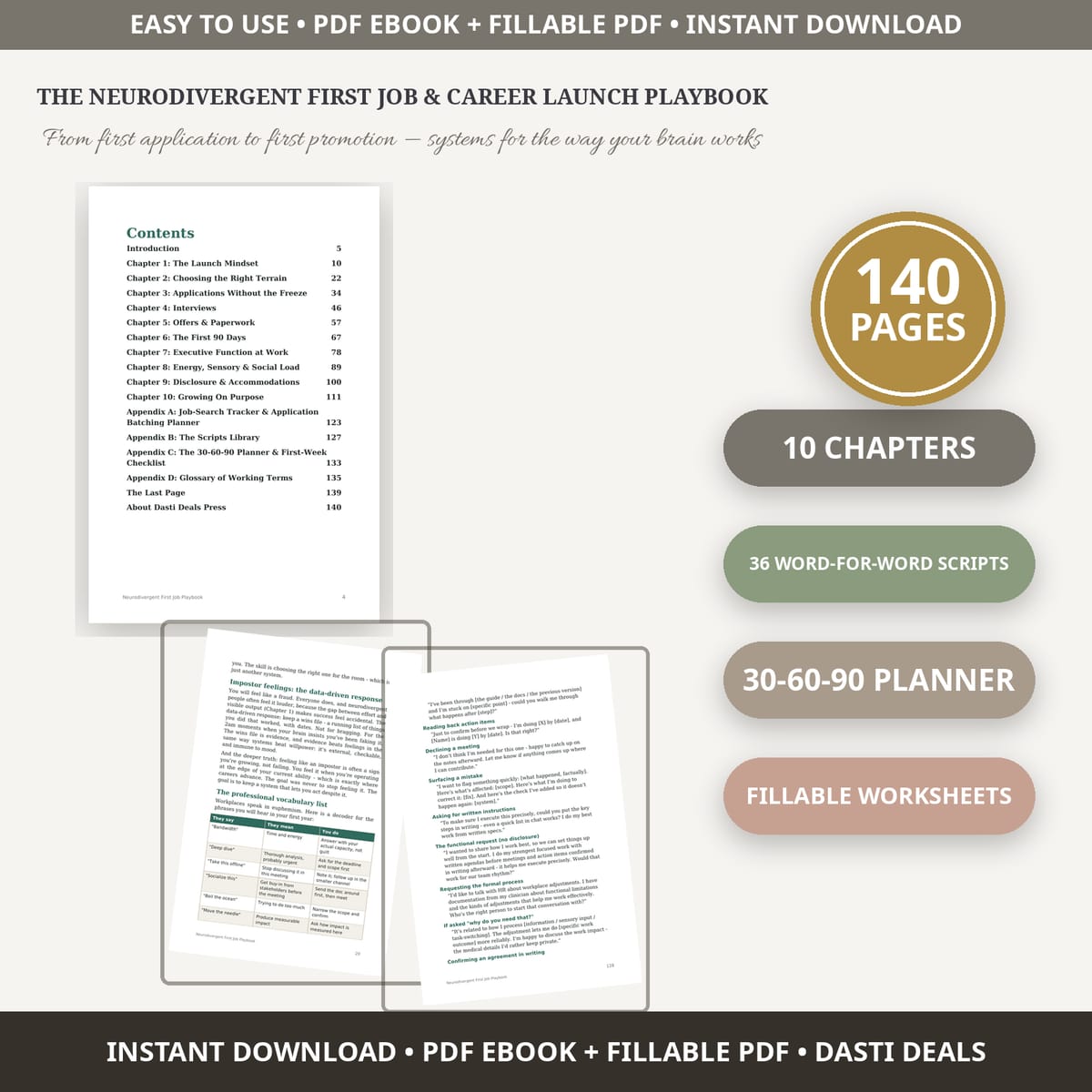
10 CHAPTERS:
THE LAUNCH MINDSET — from school rules to workplace rules; your brain as a professional asset; the unwritten-rules field guide; impostor feelings, answered with data.
CHOOSING THE RIGHT TERRAIN — reading job posts for sensory, social, and structural fit; red-flag and green-flag listings; trying terrain cheaply (internships, temp work, freelance trials); the informational interview system.
APPLICATIONS WITHOUT THE FREEZE — resume systems (build once, tailor fast), cover-letter skeletons, portfolio proof, application batching and tracking, the monthly application autopsy.
INTERVIEWS — preparation systems, answering classic questions with your real stories (STAR), sensory prep, questions to ask them, thank-you and follow-up scripts, salary conversations.
OFFERS & PAPERWORK — reading an offer letter, onboarding forms without panic, first-paycheck budget setup (a personal framework, no figures), what to ask HR before day one, background checks demystified.
THE FIRST 90 DAYS — the 30-60-90 survival map; learning names, notes, and norms; the daily capture habit; the 1:1 as your power tool; managing a difficult manager.
EXECUTIVE FUNCTION AT WORK — task systems, calendar defense, meeting survival (notes templates, follow-ups), email triage, documentation as a superpower, your personal operations manual.
ENERGY, SENSORY & SOCIAL LOAD — designing recovery into the week, the energy budget, commute systems, the Monday/Friday problem, travel and illness protocols.
DISCLOSURE & ACCOMMODATIONS — the decision framework (if, when, what to share); how accommodation requests typically work in the US (educational overview, ADA context named as US-specific); putting agreements in writing; word-for-word scripts for the manager conversation.
GROWING ON PURPOSE — feedback without the spiral, annual reviews, asking for the raise or the project (scripts), when a job is the wrong terrain, the ten-year compounding game.
PLUS 4 APPENDICES: A) Job-search tracker + application batching planner; B) 36 word-for-word scripts collected in one library; C) The 30-60-90 one-page planner + first-week checklist; D) Glossary of working terms. A separate 6-page FILLABLE worksheets PDF (188 fillable fields) is included so you can fill in every tracker and planner on screen.
DIFFERENT FROM OUR OTHER BOOKS: Product 81 ("The Zero-Nagging Executive Function Playbook") is for teens at home with parents. Product 88 ("The ADHD College Freshman Survival Guide") is for the college freshman. THIS book is the workplace: job search, interviews, the first 90 days on the job, disclosure decisions, and manager communication — written for the young professional, not the student or the parent.
IMPORTANT — PLEASE READ:
Educational career-skills guidance only. This book is NOT medical or psychological advice, and NOT legal advice. It does not diagnose or treat any condition.
The accommodations chapter is an educational overview of how disclosure and accommodation requests generally work in the US (ADA context is US-specific). It frames questions to ask and options to consider with HR and qualified professionals — never "you are legally entitled to X" instructions. Consult an employment attorney or qualified professional for advice about your situation.
No salary figures, hiring rates, or "typical" outcomes are quoted as facts. Money and careers are discussed qualitatively or as personal-budget frameworks you fill in yourself.
Original content written for this book. No copied text.
The Launch Mindset — from school rules to workplace rules; your brain as a professional asset; the unwritten-rules field guide; impostor feelings, answered with data
Choosing the Right Terrain — reading job posts for sensory, social, and structural fit; red-flag and green-flag listings; trying terrain cheaply (internships, temp work, freelance trials); the informational interview system
Applications Without the Freeze — resume systems (build once, tailor fast), cover-letter skeletons, portfolio proof, application batching and tracking, the monthly application autopsy
Interviews — preparation systems, answering classic questions with your real stories (STAR), sensory prep, questions to ask them, thank-you and follow-up scripts, salary conversations
Offers & Paperwork — reading an offer letter, onboarding forms without panic, first-paycheck budget setup (a personal framework, no figures), what to ask HR before day one, background checks demystified
The First 90 Days — the 30-60-90 survival map; learning names, notes, and norms; the daily capture habit; the 1:1 as your power tool; managing a difficult manager
Executive Function at Work — task systems, calendar defense, meeting survival (notes templates, follow-ups), email triage, documentation as a superpower, your personal operations manual
Energy, Sensory & Social Load — designing recovery into the week, the energy budget, commute systems, the Monday/Friday problem, travel and illness protocols
Disclosure & Accommodations — the decision framework (if, when, what to share); how accommodation requests typically work in the US (educational overview, ADA context named as US-specific); putting agreements in writing; word-for-word scripts for the manager conversation
Growing on Purpose — feedback without the spiral, annual reviews, asking for the raise or the project (scripts), when a job is the wrong terrain, the ten-year compounding game
4 appendices: A) Job-search tracker + application batching planner; B) 36 word-for-word scripts collected in one library; C) The 30-60-90 one-page planner + first-week checklist; D) Glossary of working terms
Every chapter ends with a "Launch Move" — one concrete action you can take this week
Neurodivergent-First-Job-Worksheets-Fillable.pdf — 6-page fillable worksheets pack (188 fillable fields) so you can fill in every tracker and planner on screen
README-license.txt — license + disclosures
Key features
Choosing the right terrain → read job posts for sensory, social, and structural fit, with red-flag and green-flag listings
Applications without the freeze → resume systems (build once, tailor fast), application batching and tracking, the monthly application autopsy
Interview systems → preparation, classic questions answered with your real stories (STAR), sensory prep, thank-you and follow-up scripts
The 30-60-90 survival map → the first 90 days: names, notes, norms, the daily capture habit, the 1:1 as your power tool
Executive function at work → task systems, calendar defense, meeting survival, email triage, your personal operations manual
Disclosure & accommodations decision framework → if, when, and what to share, with word-for-word scripts for the manager conversation
36 word-for-word scripts → collected in one library (Appendix B)
"Launch Move" ends every chapter → one concrete action you can take this week
Fillable worksheets pack → 188 fields across the trackers and planners
Frequently asked questions
Is this medical, psychological, or legal advice?
No — educational career-skills guidance only. This book is NOT medical or psychological advice, and NOT legal advice. It does not diagnose or treat any condition.
Does the accommodations chapter tell me what I'm legally entitled to?
No — it is an educational overview of how disclosure and accommodation requests generally work in the US (ADA context is US-specific). It frames questions to ask and options to consider with HR and qualified professionals — never "you are legally entitled to X" instructions. Consult an employment attorney or qualified professional for advice about your situation.
Does it quote salary figures or hiring rates?
No — no salary figures, hiring rates, or "typical" outcomes are quoted as facts. Money and careers are discussed qualitatively or as personal-budget frameworks you fill in yourself.
Who is it for — students?
No — it is written for the young professional (roughly 18–30) in the workplace. Product 88 is the college-freshman book; Product 81 is for teens at home with parents.
Are the scripts really word-for-word?
Yes — 36 word-for-word scripts are collected in one library (Appendix B), including thank-you and follow-up scripts and the manager conversation for disclosure.
Are the worksheets fillable?
Yes — a separate 6-page fillable PDF with 188 fields covers every tracker and planner.
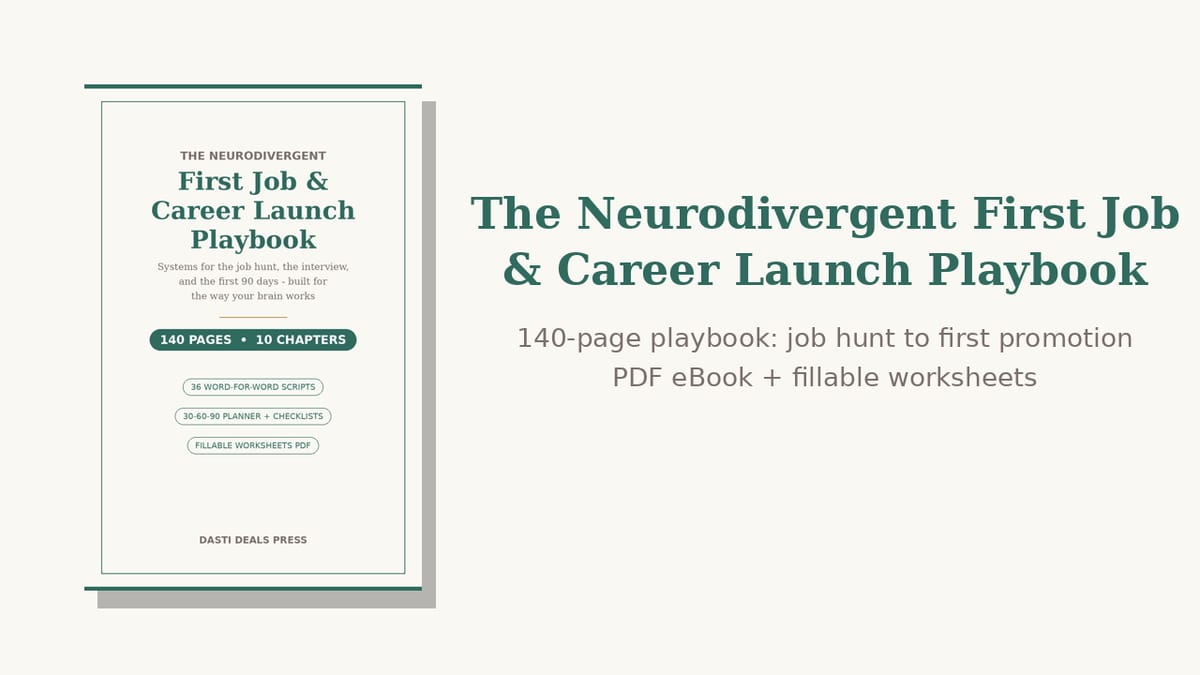
The Neurodivergent First Job & Career Launch Playbook
School had clear rules; work has unwritten rules nobody teaches. This 140-page playbook closes the gap for a neurodivergent brain — with systems, not willpower: job search, interviews, offers, the first 90 days, disclosure decisions, manager communication, and deliberate growth — plus 36 word-for-word scripts and a fillable worksheets pack.
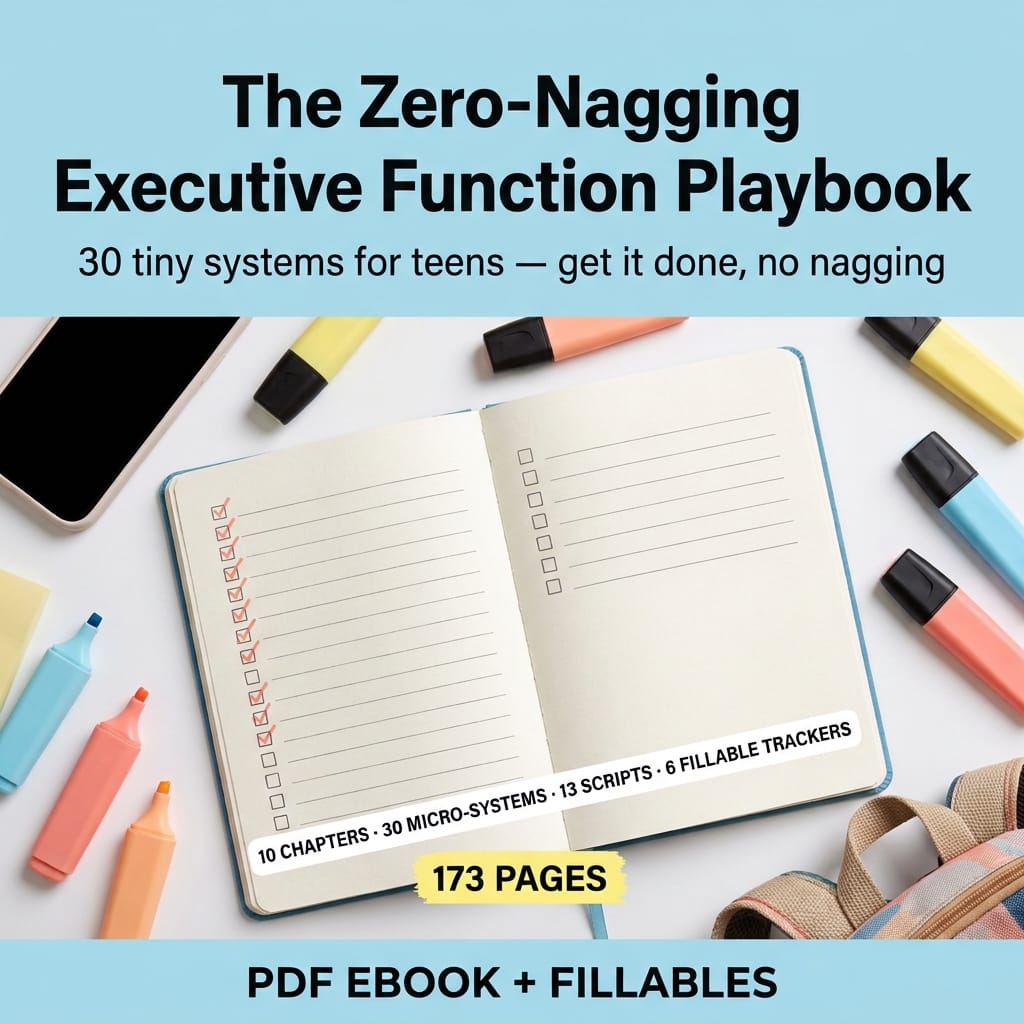
The reminding isn't a discipline problem — it's a system problem. This 173-page playbook replaces nagging with thirty tiny, permanent systems teens build themselves — each one doing a job the brain shouldn't have to do alone.
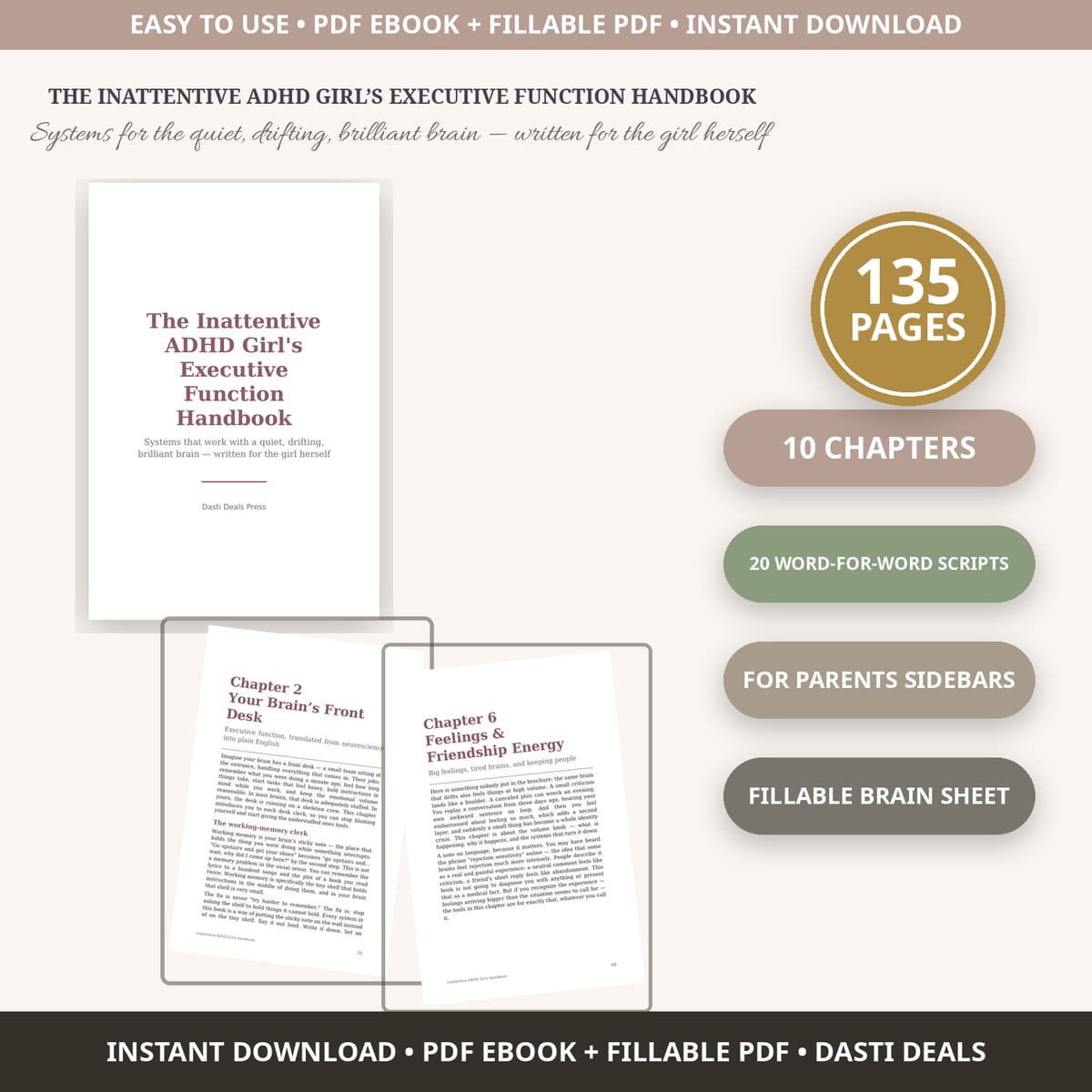
She is not the disruptive kid — she is the one staring out the window, losing the thread mid-sentence. This 135-page handbook is written TO her: executive function in plain language, and systems that work WITH a drifting brain instead of against it — school survival, time blindness fixes, the masking trap, self-advocacy scripts, and a fillable "How My Brain Works" sheet.
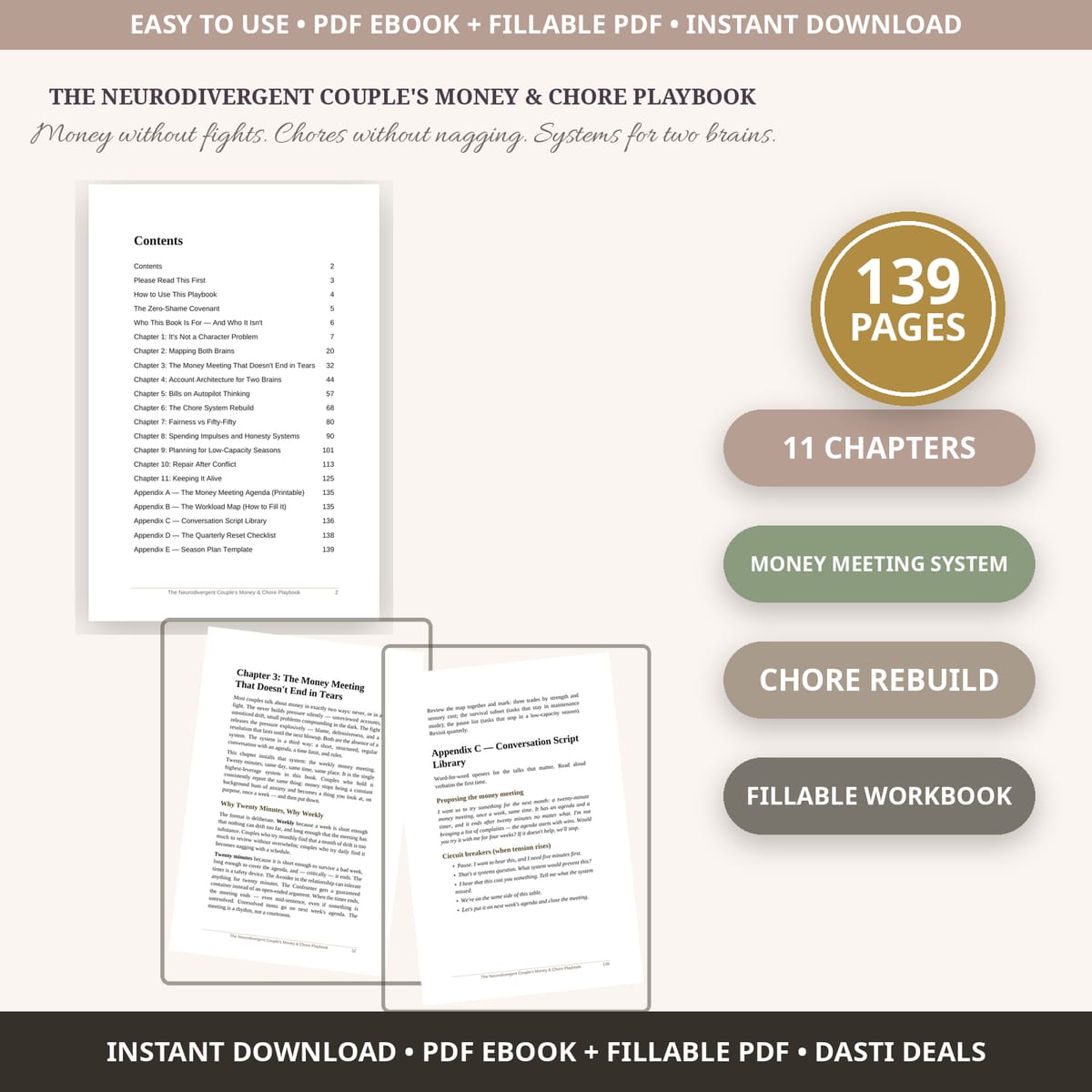
A practical household-systems playbook for couples where one or both partners are neurodivergent — and where money and chores generate more conflict than they should. Eleven chapters build a complete two-brain household operating system, plus a 14-page fillable workbook with 98 fields.
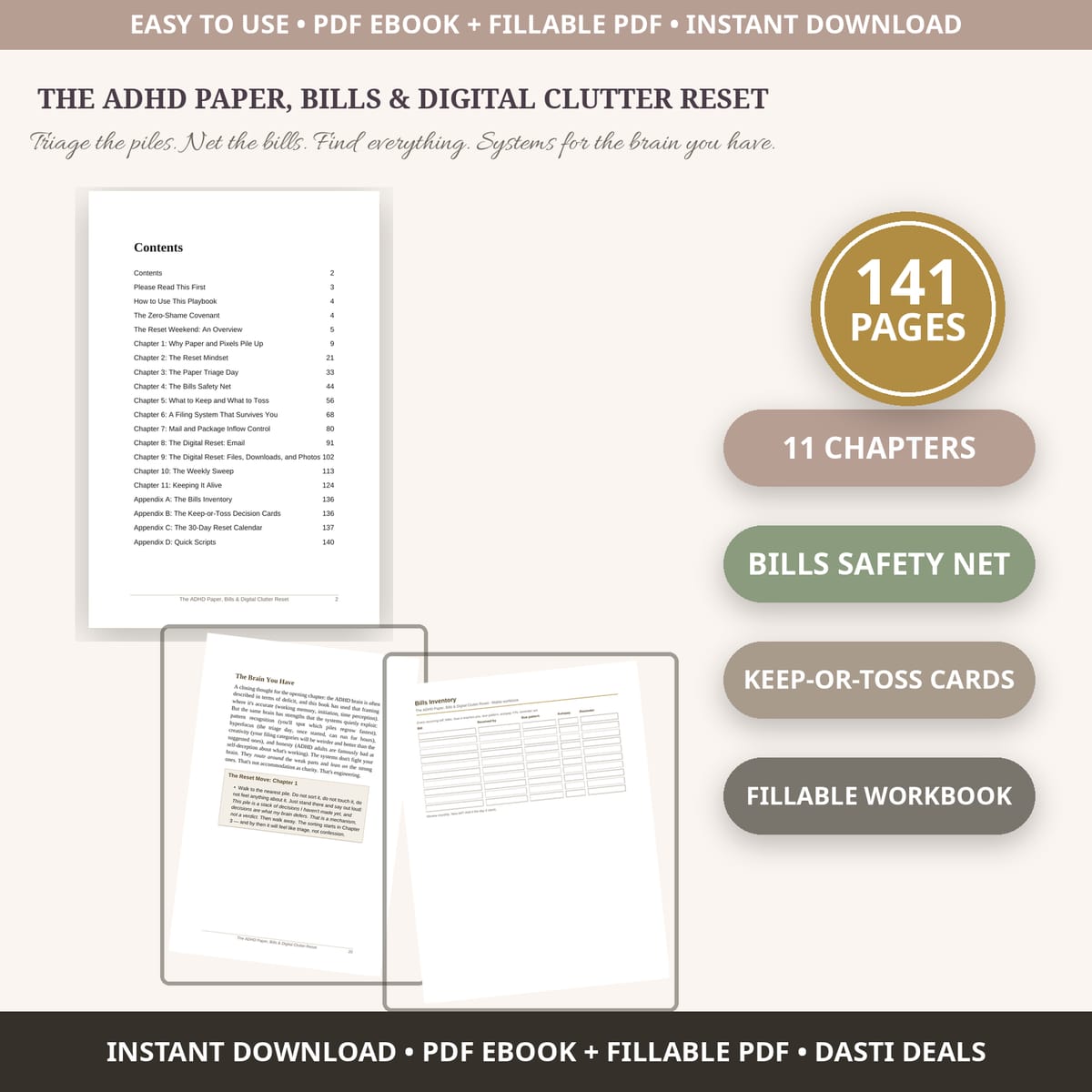
The final book in the Dasti Deals ADHD series: a 141-page reset system for paper piles, unpaid/lost bills, overflowing inboxes, chaotic downloads, and photo libraries — built for the brain you have. With a fillable 9-page workbook (141 fields) and a "Reset Move" at the end of every chapter.